 By
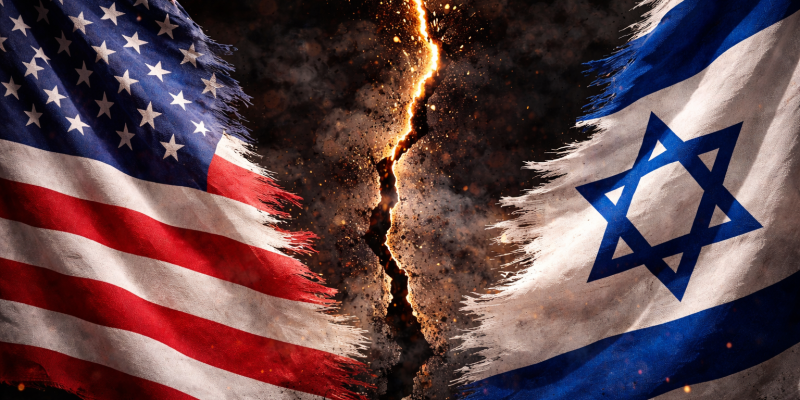
By For 60 years, the US-Israel alliance was treated as a sacred pillar of American foreign policy, but that consensus may be cracking.
What was once framed as a strategic partnership now looks increasingly like a costly state-backed arrangement: one that has delivered Israel more than $300 billion in US assistance.
The US has provided $3.8 billion annually in military financing, maintained Israel’s qualitative military edge over every neighbour, and deployed its own forces to intercept Iranian missiles targeting Israeli cities.
That tension surfaced again in a public dispute over a gas field, a resigned counterterrorism chief, and an American president saying his closest ally acted without consulting him first.
The larger question is no longer just whether Israel is an ally, but whether the relationship has become one of dependency, subsidised by Washington and underwritten by American taxpayers.
In April 2024, the US coordinated a multinational air defence coalition specifically to protect Israel from Iranian ballistic missiles.
In October 2024, American forces intercepted roughly half of a second Iranian missile barrage themselves.
Those episodes underscored something that is often missed in flatter political coverage: the alliance is not just a diplomatic arrangement, but a large, continuing economic commitment with direct fiscal, industrial, and energy-market consequences.
In return, the US receives intelligence sharing, a regional military foothold, and technology partnerships that genuinely matter.
It also receives something less often stated so bluntly: exposure to long-term strategic costs, recurring military outlays, and the burden of underwriting a security relationship whose benefits are real but highly unevenly distributed.
The relationship has always had real strategic content.
However, the exchange was never truly equal, and for decades, Washington was comfortable with that asymmetry. That bipartisan foundation is now cracking in ways that cannot be easily repaired, and the economics of the alliance are becoming harder to ignore.
How Oct 7 changed the terms?
Hamas’s October 7, 2023, attack triggered the most intense period of US military support for Israel since the country’s founding.
The Biden administration surged aid, provided diplomatic cover, and publicly stood firm.
Privately, the relationship was far more fractured.
Senior State Department officials resigned. Democrats began voting against arms packages.
And American public sympathy for Israel, which stood at 60% in 2020, fell to 36% by early 2026, the lowest recorded level in decades.
A 2025 Quinnipiac poll found that six in ten American voters opposed continuing military aid to Israel.
Congressional votes on arms sales to Israel, once automatic, became contested. That shift matters because aid is not abstract.
It is appropriate for money, defence procurement, industrial support, and a recurring line item tied to a broader system in which Washington absorbs risk, and Israel receives a level of backing that few other allies can match.
When Trump returned to office in 2025, he made the alliance intensely personal, calling for Israeli courts to drop Netanyahu’s corruption charges and interrupting a Knesset speech to urge a presidential pardon for the prime minister.
Are the two nations aligned on Iran war’s goals?
Operation Epic Fury, launched February 28, 2026, was sold as a joint US-Israel campaign with clear objectives.
Within three weeks, it revealed that the two countries were not fighting the same war, and that divergence had major economic implications as well as military ones.
Trump’s stated goals were to destroy Iran’s ballistic missile capability and navy and eliminate the nuclear program.
Israel’s goals were to decapitate the Iranian leadership, dismantle its industrial base, and permanently reorder the region.
Tulsi Gabbard, Trump’s Director of National Intelligence, confirmed this to Congress in plain language.
“The objectives that have been laid out by the US President are different from the objectives that have been laid out by the Israeli government.”
That sentence, spoken under oath by a senior administration official, is the most honest public description of the alliance’s structural problem in years, because it exposed a split not just in strategy but in expected costs, risk tolerance, and end-state economics.
The South Pars strike crystallised it.
Israel bombed one of the world’s largest gas fields without, according to Trump, telling him first. Israeli officials disputed that.
The public contradiction between allies, played out on Truth Social and in press conferences simultaneously, sent energy markets into another spiral and left Gulf states furious.
It also reminded investors and policymakers that the alliance now has direct consequences for commodity prices, shipping insurance, regional investment, and the broader cost of doing business in a destabilised Middle East.
Oman’s foreign minister wrote openly that America had been dragged into a war when diplomacy was still possible.
“This is not America’s war,” he said.
Joe Kent, Trump’s own former director of the National Counterterrorism Center, resigned and wrote that the US had been pushed into conflict “due to pressure from Israel and its powerful American lobby.” These are not fringe voices.
What the alliance looks like from here?
The military and intelligence ties between the US and Israel run deep and will not dissolve over one war.
Technology partnerships, cybersecurity cooperation, defence industry integration, and joint research networks have built institutional connections that outlast any individual crisis.
Those ties also create constituencies on both sides of the relationship, from contractors and investors to intelligence agencies and manufacturers, which helps explain why the alliance persists even when public confidence weakens.
Israel recorded a record $14.7 billion in defence exports in 2024, most of them to Europe, reflecting a country that is increasingly capable of operating independently on the world stage.
That matters economically because it suggests Israel is no longer only a security recipient but also an arms exporter and defence innovator with its own commercial base.
In other words, the relationship is not simply one of American support for a vulnerable ally; it is also a channel through which Israeli defence capacity, technology, and industrial partnerships feed back into global markets.
But the political foundation of the alliance has never been weaker.
The Carnegie Endowment for International Peace noted recently that fissures within the traditionally supportive pro-Israel American community “may not heal easily” and could outlast Netanyahu himself.
That warning has an economic subtext too: once a relationship depends on sustained political subsidy, the erosion of bipartisan support raises the cost of maintaining it and increases the likelihood that future aid will come under tighter scrutiny, sharper conditions, or outright opposition.
The deepest problem is not Netanyahu or Trump or any specific decision made in the past three weeks.
The deepest problem is that the alliance was built on the assumption that Israeli and American interests were fundamentally aligned.
That assumption held through the Cold War, through the war on terror, and through multiple cycles of Middle East instability.
The 2026 Iran war has tested it in a way that no previous episode did, by forcing both countries to pay real, measurable, ongoing costs for a set of objectives they never fully agreed on in the first place.
The special relationship still exists. It just no longer comes for free.
The post Is Iran war testing US-Israel alliance as costs soar? appeared first on Invezz