
 By
By Missiles are flying across continents, oil tankers have stalled, and insurance costs are surging.
Around the world, people are asking the same question: Are we entering another global energy crisis?
The conflict involving Iran, the United States, and Israel has shaken energy markets from Asia to Europe.
Oil prices have climbed, gas costs in Europe have spiked, and major shipping routes—responsible for a large share of the world’s fuel—have suddenly become perilous.
The world’s most critical energy chokepoint
Every major energy shock has a geographic epicentre, and this time it’s the Strait of Hormuz.
This narrow waterway links the Persian Gulf with global markets, carrying roughly a fifth of the world’s oil and about 20% of global LNG shipments—nearly 20 million barrels of crude each day.
When shipping insurance suddenly jumped from around $200,000 per voyage to close to $1 million, tanker operators pulled back.
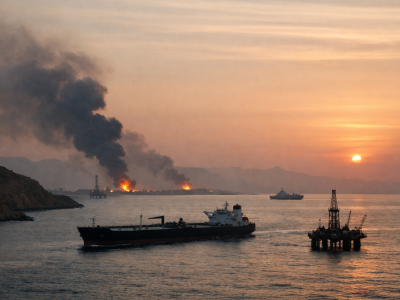
Several vessels were hit near the strait, and marine insurers withdrew coverage. Traffic slowed sharply.
Energy markets reacted immediately. Brent crude climbed to roughly $80 per barrel.
European gas prices surged more than 50% in a matter of days after LNG supply fears intensified and production in Qatar was temporarily halted following regional strikes.
For energy markets, the issue is not oil that no longer exists. The problem is oil that cannot move.
Why have prices not exploded yet?
Despite the war, oil prices remain far below crisis levels seen in recent history.
When the Russian invasion of Ukraine triggered Europe’s energy shock in 2022, Brent crude surged above $130 per barrel.
Today, it trades near $80.
Part of the explanation lies in how the market looked before the conflict began.
Oil supply was relatively comfortable. Some traders even expected a mild oversupply this year.
Large volumes of Iranian and Russian crude were sitting in floating storage on tankers.
Those barrels now provide a cushion.
Another stabilising factor is emergency reserves. After the 1973 oil crisis, countries built strategic petroleum reserves coordinated through the International Energy Agency.
Member states are required to hold about 90 days of emergency supplies.
These buffers did not exist during earlier crises.
Energy markets themselves also look very different from the 1970s.
Oil once produced about a quarter of global electricity. Today it accounts for less than three per cent.
Electricity now depends on a mix of gas, nuclear, renewables and coal.
Oil shocks still matter. They simply do not ripple through the system in the same way.
The real danger: shipping disruption
The central risk is not a shortage of oil fields. It is a blockage in the transportation system.
Producers in the Persian Gulf rely on the Strait of Hormuz to export crude. When tankers stop moving, oil piles up quickly. Some countries lack storage capacity and must cut production.
Iraq has already reduced output by roughly 1.5 million barrels per day because it cannot store unsold crude. If shipments remain blocked, similar reductions could spread across Gulf exporters.
The consequences would move quickly through fuel markets.
Gasoline, diesel and jet fuel prices tend to react faster than crude itself because refiners and distributors face immediate supply constraints.
Consumers rarely buy crude oil. They buy refined products. When those rise sharply, inflation follows.
Which countries are most exposed?
Energy shocks rarely hit all economies equally. Exposure depends on import dependence and where those imports originate.
Asian industrial economies sit at the front line. China is the world’s largest oil importer and relies heavily on Middle Eastern supply.
India imports about 5 million barrels per day, much of it from Gulf producers such as Saudi Arabia, Iraq, and the United Arab Emirates.
India already requested temporary relief from sanctions rules to import additional Russian crude after supply disruptions threatened refinery operations.
Japan and South Korea face similar exposure. Both import nearly all of their fossil fuels and rely heavily on shipments passing through Hormuz.
Europe sits one step further from the immediate shock but remains vulnerable through gas markets. The continent replaced much of its Russian pipeline gas with LNG after the Ukraine war. Cargoes from Qatar and the United States now fill that gap.
Competition with Asia is already visible. One LNG tanker originally bound for France reversed course mid-voyage and headed to Asia, where buyers were willing to pay more.
European storage levels also entered the conflict unusually low. Refilling reserves before next winter could become expensive if prices remain elevated.
Emerging economies feeling the pressure
The ripple effects extend beyond major energy importers.
In Egypt, the war threatens revenue from the Suez Canal, a critical source of foreign currency. Some shipping companies now avoid the region entirely and reroute around Africa’s Cape of Good Hope.
The Egyptian pound recently fell to an eight-month low as capital flows reversed.
Meanwhile, Cuba faces a different type of energy shock. Fuel shortages linked to supply disruptions and sanctions have led to rationing, transportation shutdowns and widespread power outages.
These economies lack the financial buffers available to larger importers.
Even moderate energy price increases can quickly spill into currency instability and inflation.
When a global energy crisis becomes real
History shows that energy crises rarely arise from a single event. The 1970s oil shocks combined geopolitical tensions with structural supply constraints.
The 2022 crisis followed years of underinvestment in energy infrastructure, along with disruptions to nuclear and hydropower generation in Europe.
Today’s conditions are different.
Oil supply remains adequate. Coal prices have barely moved. Electricity markets show little sign of panic. North American natural gas remains abundant.
The real tipping point lies in the Strait of Hormuz.
If tanker traffic resumes, the current disruption will likely remain manageable.
If the waterway stays closed for weeks or months, the global market could lose up to 20 million barrels per day of supply.
At that point, the term global energy crisis would stop sounding hypothetical.
The post Are we staring at global energy crisis with Strait of Hormuz blockade? appeared first on Invezz