 By
By Cuba’s fragile economy is facing renewed strain as US pressure intensifies, raising concerns about how far the situation could escalate.
President Donald Trump said on Monday he expected to have the “honour of taking Cuba”, adding that he could do anything he wants with the island.
The remarks come as Cuba deals with a severe energy crisis following a US-imposed oil blockade.
While any takeover remains hypothetical, the combination of political pressure, disrupted fuel supplies, and ongoing negotiations has increased uncertainty around the country’s economic stability.
Oil blockade impact
Cuba’s economic stress has deepened since the US cut off Venezuelan oil shipments, a critical source of fuel for the island.
The move followed Washington’s seizure of Venezuelan president Nicolás Maduro in January, removing Havana’s main external supporter.
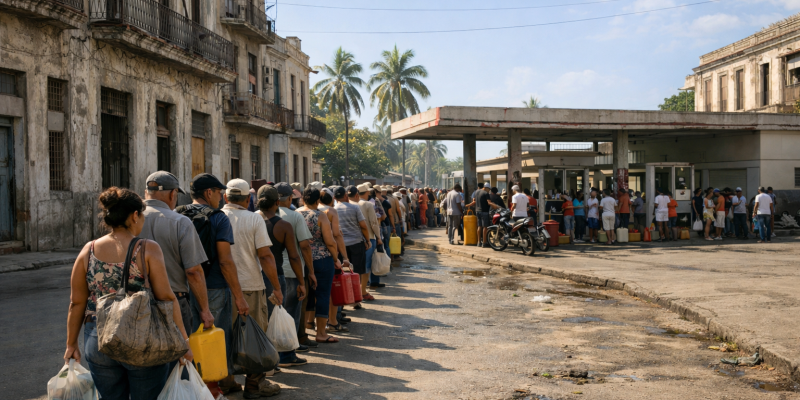
The loss of oil imports has exposed weaknesses in Cuba’s ageing energy system. A nationwide power blackout recently halted daily life and disrupted economic activity.
Manufacturing, transport, and public services have all been affected, making recovery more difficult.
Washington has also warned it could impose tariffs on countries supplying oil to Cuba.
This has further limited Havana’s options, tightening access to energy and increasing costs for an already strained economy.
Talks and conditions
Trump’s comments came alongside ongoing discussions between US officials and Cuban authorities.
Reports suggest Washington has asked Cuba to remove President Miguel Díaz-Canel as part of recent talks.
Such a demand introduces additional economic uncertainty. A leadership change could alter policy direction, but would not necessarily address structural challenges within Cuba’s state-led system.
Díaz-Canel, who succeeded Raúl Castro in 2018, has said negotiations must respect sovereignty and self-determination.
Cuba has historically rejected external interference in domestic governance.
This position has often been a key obstacle in reaching agreements with the US, and remains central to current talks.
Regime shift risks
US policy towards Cuba has increasingly focused on regime change.
Secretary of State Marco Rubio has long supported this approach, and Trump has previously suggested that a takeover could occur, noting it may not be friendly.
Even the possibility of such a shift is affecting economic sentiment.
Trade partners and financial counterparts may become more cautious as uncertainty rises.
Access to foreign capital and credit, already limited, could face further pressure if tensions escalate.
At the same time, the absence of Venezuelan support leaves Cuba with few alternatives to stabilise its energy supply.
This makes the economy more vulnerable to external shocks and policy shifts.
Economic uncertainty rises
Trump described Cuba as a weakened nation, reflecting the broader economic picture.
Years of sanctions, declining external aid, and infrastructure challenges have constrained growth.
A potential US intervention or takeover could lead to major economic restructuring, but the transition period would likely be disruptive.
Supply chains, state services, and financial systems could face further instability before any longer-term changes take shape.
For now, the scenario remains uncertain.
However, the combination of an oil blockade, political demands, and escalating rhetoric is increasing pressure on Cuba’s economy, with risks of a deeper crisis continuing to build.
The post How US pressure could tip Cuba’s fragile economy into deeper crisis appeared first on Invezz