
 By
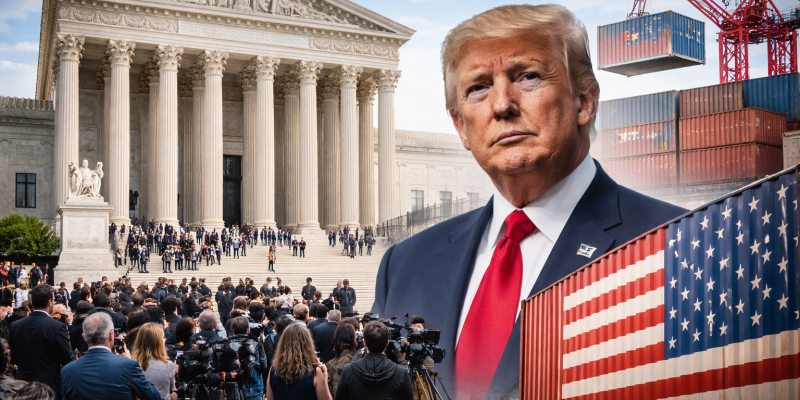
By The US Supreme Court could deliver today what could be a landmark ruling on President Donald Trump’s most sweeping global tariffs.
The court has indicated on its website that Friday is scheduled as an opinion day, when it typically releases decisions in argued cases.
While there is no certainty that the tariff case will be among them, the timing marks the first opportunity for the justices to rule on the legality of Trump’s so-called “Liberation Day” tariffs, heightening anticipation across Wall Street and corporate America.
At its heart, the case turns on two questions: whether the administration has the authority under the International Emergency Economic Powers Act to impose the tariffs, and, if not, whether the US would be required to refund duties already paid by importers.
IEEPA adherence and refunds in focus
The case centres on whether the Trump administration lawfully relied on the International Emergency Economic Powers Act of 1977 to impose wide-ranging duties on US trading partners.
The law was designed to give presidents authority to act during national emergencies, but challengers argue it was never intended to justify sweeping, long-term tariffs.
The court heard arguments in early November, when both conservative and liberal justices voiced scepticism about the administration’s interpretation of the statute.
Several questioned whether Congress had truly delegated such expansive trade authority to the White House.
If the court rules that the use of IEEPA was improper, a second issue immediately follows: whether importers who have already paid tariffs are entitled to reimbursement.
Reuters reported that trade lawyers and customs brokers estimate that refunds could total as much as $150 billion, setting up a complex and potentially protracted battle with the federal government.
Markets brace for multiple outcomes
The uncertainty has kept investors on edge.
Prediction market Kalshi currently assigns just a 28% probability that the Supreme Court will fully uphold the tariffs as implemented.
However, legal experts caution that the ruling does not have to be all-or-nothing.
The justices could narrow the scope of the president’s authority, limit how the law can be used in future, or allow some tariffs to stand while striking down others.
Morgan Stanley analysts said there is “significant room for nuance” in the decision.
“The Supreme Court could fully repeal, or fully back, the President’s IEEPA tariffs. However, we think there’s room for nuance…the court “has wide latitude when it comes to issuing decisions, a range of outcomes is possible, like the Court narrowing the scope of existing tariffs but not mandating their full removal or limiting the future application of tariffs,” Morgan Stanley analysts Ariana Salvatore and Bradley Tian said in a note.
Trump himself has repeatedly warned that losing the ability to impose tariffs would be a “terrible blow” to the US, underscoring how central trade policy has become to his economic agenda.
Striking down of tariffs could act as tailwind for markets
The prospect of a ruling has revived memories of last April, when Trump’s tariff announcement triggered a sharp sell-off.
US stocks fell nearly 5% and Treasury yields dropped as investors fled to safe havens.
While markets have since rebounded, with stocks up more than 16% in 2025 and hitting record highs, analysts say a clear decision could still act as a catalyst.
Wells Fargo chief equity strategist Ohsung Kwon has estimated that striking down the tariffs would lift S&P 500 earnings before interest and taxes by about 2.4% in 2026 compared with last year.
Such an outcome would likely prompt investors to reprice equities higher.
James St. Aubin, chief investment officer at Ocean Park Asset Management, said a ruling against the tariffs would be “a catalyst for a little bit of a rally,” particularly for companies heavily exposed to imported goods.
Not all sectors would benefit equally.
Consumer-facing businesses and retailers, which have borne the brunt of higher import costs, stand to gain the most.
Financial firms could also benefit from a more confident consumer backdrop.
By contrast, Haris Khurshid, chief investment officer at Karobaar Capital, said materials, commodities and domestic producers that benefited from protectionist policies could lag if tariffs are rolled back.
Kyle Rodda, senior financial markets analyst at Capital.com, described the ruling as the “real wildcard” for markets.
While a negative decision would boost sentiment, he said the administration is unlikely to abandon tariffs altogether and would seek alternative routes to maintain levies.
Likely impact on bond markets
A decision against the tariffs could also hit US government revenues, potentially pushing Treasury yields higher and adding volatility to bond markets.
JPMorgan strategists warned that removing tariffs could rekindle fiscal concerns and steepen the yield curve, though they expect any impact to be limited.
“A favourable ruling for the tariffs would likely be taken as risk-positive, removing a source of uncertainty. But an unfavourable ruling could push Treasury yields higher as the market digests the fiscal implications of large-scale refunds,” said Chris Beauchamp, chief market analyst at IG.
A ruling that requires the government to refund past tariff collections could also lead to increased Treasury issuance.
Economic impact so far has been muted
Despite fears that sweeping tariffs would fuel inflation and isolate the US from global trade, the economic impact to date has defied some projections.
Inflation effects have been limited, while the US trade deficit has narrowed sharply.
In October, the trade imbalance fell to its lowest level since the aftermath of the 2009 financial crisis, reflecting weaker imports rather than a surge in exports.
This has bolstered the administration’s argument that tariffs are reshaping trade flows without derailing growth.
Morgan Stanley’s base case assumes that tariff rates remain broadly unchanged after the court decision.
Under that scenario, the bank expects only modest economic effects, estimating an effective tariff rate of around 16% by the end of 2025 and a cumulative impact of roughly 70 basis points on core PCE inflation, much of which has already been absorbed.
A landmark moment for trade policy
For companies, the stakes are high.
Executives across manufacturing, retail and logistics have been bracing for clarity on whether tariffs will remain part of the cost structure or unwind suddenly.
Customs brokers and lawyers warn that even if refunds are ordered, the process could take years.
Beyond the immediate market reaction, the ruling could set a lasting precedent on how future presidents use emergency powers to influence trade.
A clear rebuke would strengthen Congress’s hand, while an endorsement could entrench executive authority over tariffs for years to come.
As Friday approaches, investors, businesses and policymakers alike are watching closely.
Whether the Supreme Court strikes down the tariffs, trims them back, or leaves them largely intact, the decision is set to reverberate well beyond the courtroom.
The post What do markets expect from US Supreme Court’s ruling on Trump’s tariffs appeared first on Invezz